Q: When did you first get interested in writing?
A: I've known since I was a little kid that I wanted to write books. My maternal grandfather, Solomon Feldman, was a high-school biology teacher who wrote biology textbooks on the side. I wanted to be just like him when I grew up.
Q: What books or authors inspired you, and what did you take away from them?
A: My two biggest inspirations were Kurt Vonnegut and Frank McCourt. Both wrote very funny books about searingly sad topics, which is what I try to do, as well.
Q: Writing a book, especially your first, must be intimidating. How do you begin writing?
A: I always do a ton of research before I even think about starting to write. I also make sure I have a general outline. Finally, I have to be able to see the final scene in the novel very clearly, almost as though it were a little movie in my head, before I start writing the first scene. It's much less daunting to write the book if you have lots of background info, and if you know where the plot is going.
Q: Many people have things they do when they get writer's block. Do you ever find yourself in a writer's block? If so, what do you do to get yourself out?
A: I don't have any foolproof strategies. I tend to walk away from the computer and go exercise when I am stuck. If that doesn't work, at least I've gotten some exercise out of the deal.
Q: What is your personal favorite book you have written? Why is it your favorite?
A: I like Notes from the Midnight Driver and Curveball, because each of them features a character based on my Grampa Sol. I like feeling that I have immortalized him in some way, because he was very, very important to me.
Q: I noticed that your books usually have some references to music. What do you believe is the correlation between music and writing?
A: Well, I don't have any kind of grand theory about the relationship between music and writing. However, music is like oxygen to me: I can't live without it, and it flows in and out of me all the time without any conscious volition on my part. I can't help but write about it!
Q: I know that you're a musician as well as an author. Do you feel like there are maybe certain things that can be expressed better through music rather than literature?
A: Hmm … great question. But I don't have an answer. I will say that playing music provides a physical release for me that writing doesn't. So the two serve different emotional needs for me, as a practitioner.
Q: What are some of your favorite bands and musicians? Why are they your favorite?
A: The Beatles are my all-time fave. Because, um, they're the Beatles. Speaking of music, your latest book, Are You Experienced, takes place at Woodstock. What is needed to write a fictional book in a real place and time while making it as accurate as possible?
A: It takes an extraordinary amount of research. I read biographies of various Woodstock figures, as well as numerous books about the event itself. I also watched the documentary film repeatedly, went to the concert site and museum, interviewed several people who had attended the festival, listened to countless hours of music, and viewed tons of footage of Jimi Hendrix. Because Hendrix is a fairly major character in my book, I wanted to be sure I had a handle on his speech patterns.
Finally, I made a big chart of every hour of the festival weekend, which included information like which band was playing, the weather, and other stuff that was happening at that time such as food shortages or famous stage announcements. I referred to my chart constantly while writing the book.
Q: I felt a need to mention Drums, Girls, and Dangerous Pie because it was a book that really changed my opinion on a lot of things. It was the first book I couldn't put down, and it inspired me to get into reading for fun. When I met you in middle school, I remember being so nervous to talk to you because you were really my first idol. Have there been any stories from your fans that you were truly amazed by? Did you ever think your writing could impact someone's life?
A: First of all, wow -- thank you, Declan! Second, to answer your question: I have been blown away by the responses people have had to my work. When I was a kid, my favorite novel was The Dark is Rising, by Susan Cooper, which I first read right around the time I was entering middle school. I got to meet Susan Cooper when I was 34, after my first book had come out, because we were both signing books at the same convention in Texas. My hands were literally shaking when I was face-to-face with her, because even as an adult and a fellow author, I was overwhelmed by how much her work had meant to me. I was a miserable kid during those preteen years, and her books were a lifeline for me. To think that my work could serve that function, or even anything remotely close to it, for anyone else, is kind of ridiculous to me.
My favorite reader stories are the ones that are closest to my original purpose in writing Drums. When a family member of a cancer patient says that Drums or its sequel, After Ever After, helped him or her to get through the cancer experience, I feel incredibly lucky that my work somehow got out there into the world and found its way into that person's hands.
Wednesday, September 24, 2014
Monday, September 22, 2014
Breaking Benjamin Comeback Concert First Live Show in Four Years
On Tuesday, September 16th, Breaking Benjamin announced two comeback shows at Gator’s Pub and Eatery in Luzerne, PA. Seven hundred tickets went on sale for Friday, September 19th, and Saturday, September 20th.
These shows marked their first live appearances in four years. The band had been broken up for four years, but last month there was an announcement and teaser on their Facebook page that they were back with a new lineup.
I was lucky enough to get tickets within a few hours of them selling out. Here’s my review of the Saturday show.
I arrived to the venue around 4:40 PM, with doors opening at 7 PM and the show starting at 8 PM. The parking lot was very small so we were forced to park on a local side street. About fifteen to twenty people were lined up at two separate doors.
After about twenty minutes of waiting in line, front man Ben Burnley came out to greet fans and take photos. He was generous and humble, and you could tell how much he appreciated everyone coming out to see the band. One girl told him how his music saved her life and prevented her from suicide. He warmly responded and addressed the rest of the line saying, “Never give up”.
Fans began filing in the venue at 7 PM and everyone was very friendly to each other. Autographed shirts were available at the merch table and made for a great souvenir of the once in a lifetime experience.
The lights went out and the packed venue cheered as Breaking Benjamin made their entrance to the stage.
The band began the show with “So Cold”, and there wasn’t a single person not singing with them.
The band went on to play other favorites such as “Follow”, “Unknown Soldier”, “Home” and “Breath”. They also did a rendition of “Them Bones” by Alice in Chains, which Burnley began by saying, “This is a song by one of my favorite bands’.
The crowd was the best I have ever seen at a show. There was no moshing or pushing and even the security guards were singing the songs. This allowed Burnley to come to the guard rail and get even closer to the fans.
The new lineup that included three guitars added a deeper element and heavier sound while drummer Shaun Foist was steady but brought feel to the music, and bass player Aaron Bruch provided heavy bass lines and backup vocals that complimented lead singer Ben Burnley.
Burnley took a moment toward the end of the show to say, “With all the people in this world, I want everyone here to treat everyone kindly and take time out of every single day to do one good deed”.
The band ended their set with perhaps their biggest hit, “Diary of Jane”. They then huddled and threw out guitar picks and drum sticks out into the crowd as they exited the stage.
The crowd began chanting, “One more song!” After a minute of chanting, the crowd erupted with applause as front man Ben Burnley came back to the stage.
He did two more songs solo and then left the stage saying, “I love you guys. Thank you so much for coming out”.
As he left, more chants began saying, “BB (Breaking Benjamin) is back!”. Burnley looked like he had a few tears in his eyes as he looked at the crowd one last time and went backstage.
Wednesday, February 26, 2014
Interview: Stephen Blickenstaff | Art On "The Cover of Rolling Stone"
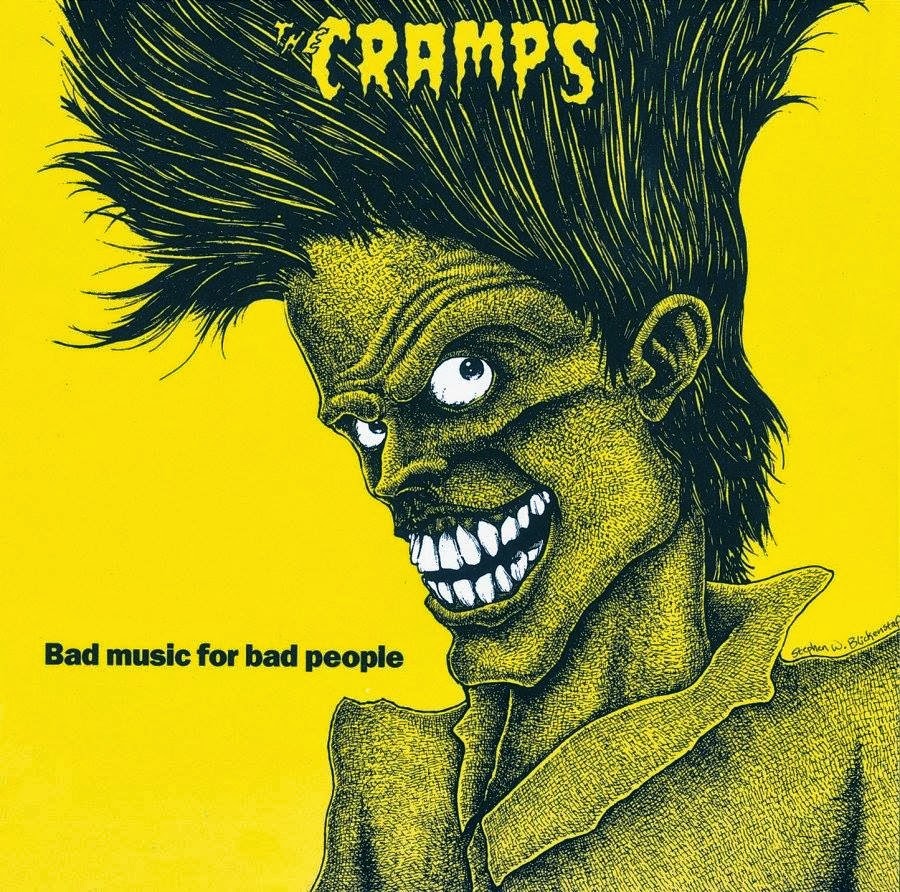
Stephen Blickenstaff's art was recently featured on the cover of Rolling Stone when Lorde was wearing a Cramps t-shirt on the cover. I asked Stephen how he felt about it.
Q: How did you find out about your work being on the cover of Rolling Stone?
A: One of my friends brought it to my attention on Facebook.
Q: What was your reaction to finding out?
A: At first I thought it was a joke. I thought it was a fake magazine cover that someone had Photoshopped. After I realized it was real I thought it was pretty crazy. I'm used to seeing the image around in lots of places since it's been bootlegged so much, but to see it on the cover of Rolling Stone magazine was a real surprise.
Q: I understand that you didn't know Lorde before seeing the cover with her wearing the shirt of your design. Did you listen to her music after seeing it?
A: I've still heard very little of her music. I plan to find out more about her. I know a lot of people are really coming down on her for wearing the Cramps T-shirt in the Rolling Stone cover photo, saying she probably doesn't even know who they are, but from a few short articles I've read she seems quite aware of, and also a fan of a lot of the old school stuff that I like. And I think it's fantastic that she's thrown a spotlight on The Cramps. Hopefully a lot of young people will discover their music now.
Q: When you first made the artwork, did you ever think it would become as popular as it did?
A: I would have never guessed.
Q: After making it on the cover of Rolling Stone, is there anything else you would like to accomplish?
A: I was joking with a friend that I'd like to see the Cramps art worn by an astronaut in space. But yeah, there are lots of other things I'd like to accomplish. There are plenty of things rattling around in my head trying to get out.
Tuesday, December 3, 2013
Interview: Doug Benson | Commodore Studio
Commodore Studio is the latest recording studio addition to the Frederick, MD area. The studio may be new, but the staff is far from inexperienced. I talked to the owner, Doug Benson, about his new location and his involvement in music through the years.
Q: Why did you decide to open the studio?
A: Audio is “what I do.” It’s always best when someone chooses a career in a field that interests them. It’s also good to be able to offer a service that people need.
Q: Why did you choose the location you did?
A: Thurmont is a nice mid-point between Northern Maryland and Southern Pennsylvania. It’s also where I live, so it’s easy for me to get to the studio on short notice if I need to.
Q: What would you say makes you different from other studios?
A: Experience. I’ve been involved in audio production since the late 1970s, so I’ve lived through the advances in recording technology that have occurred in that time. Digital recording did not even exist when I first started out!
Q: What work are you most proud of being involved in?
A: The Grammy-nominated historical release of King Oliver’s 1923 jazz band, in which I did all the audio restoration and contributed to the album notes.
Q: What made you want to get involved in studio work?
A: What makes someone interested in science or sports or cooking or art? Sometimes it’s just in our DNA!
Q: What do you hope for the studio to accomplish in the upcoming years?
A: Of course I would like Commodore to become a successful growing business, but I also want to help attract business to other Thurmont businesses. On my website I have a long list of other local merchants, restaurants and attractions. We can all work together to aid in each other’s success.
Q: What is the most important thing that an artist should know before recording at a studio?
A: When clients ask me how long it will take, I have to tell them it depends completely on how prepared THEY are when they come in. In the studio, time is money, so don’t book a session unless you know exactly what you want to accomplish and how you intend to accomplish it. A self-described “rap producer” once showed up to a session with nothing but some unfinished lyrics scribbled on a page. He asked me: “so where are all your beats and stuff?” and expected his song to be finished for him with a few mouse clicks. Needless to say, the session didn’t go as quickly as he had planned!
Q: Many people these days think they can record their music at home. What are the differences recording in an actual studio?
A: Some types of music can be recorded successfully at home. For example, rap and hip-hop are primarily computer-based styles, where artists work with pre-recorded “loops” that were played in real studios by other musicians. Personally I think it’s a bit odd to drag-and-drop pieces of other people’s performances and then say “listen to the song I wrote,” but it’s become an accepted practice. Often, a single microphone for the lead vocal is all that is needed for that type of recording.
On the other hand, a rock band or a classical group needs more space than can be found in a typical bedroom studio. The acoustics of a recording room are important to performers, so they will play better wherever they feel more comfortable. Also, some types of microphones are more suitable than others for different sources. For example, the ribbon microphone we use for a guitar cabinet would not pick up the subtle nuances of a violin successfully. A condenser would be a better choice. An “actual” studio (as you put it) will usually have a nice array of different microphones as well as a grand piano, isolation booths for vocalists and drummers, higher-end tube preamps and compressors, digital plug-ins and all the gear that makes recordings sound like contemporary CD releases. (All the same gear that was used to create the “loops” that bedroom studios take for granted.)
Q: I think it’s awesome that you do audio restoration. I personally believe in listening to a lot of rare music that can only be found in certain formats. Why is audio restoration so important to the world of music?
A: I think of it as history. If we had to opportunity to actually go back and watch the signing of the Declaration of Independence rather than just read about it, wouldn’t that be more exciting? With early sound recordings we have an actual audio document of something that happened decades (or centuries) ago. The earliest existing recordings go back to the first half of the 19th century, and as technology improves we can restore them more clearly every few years. Just twenty years ago, the brown wax cylinders recorded (without electricity) by the Edison company in the 1880s and 1890s were almost inaudible. Now we can remove surface noise and enhance the recorded signal with almost shocking clarity. This allows us to hear the performance in greater detail. It’s like finding a missing piece of a famous document that enhances our understanding of an event.
Thursday, November 21, 2013
Unknown Music Spotlight
I often find bands and wonder why so many people don’t know about them. Each week I will try to showcase these bands to you in a segment I am calling the Unknown Music Spotlight.
This week I am highlighting three bands from the Washington D.C. area: Faraquet, The Slickee Boys, and The Evens.
Faraquet
Faraquet was a short lived band that only lasted from 1997 to 2001. In that amount of time they released a few EPs, but only one full length album. The full length album, The View From This Tower, is a post-hardcore jazz infused masterpiece. They are classified as a math rock band, but in reality they are a mixture of unique genres. The band did get back together in 2008 to release a compilation album of their early singles and EPs and reunion shows around Brazil and Washington D.C.
Songs to try out first:
“The View From This Tower”
“Carefully Planned”
“Study In Complacency”
“The View From This Tower”
“Carefully Planned”
“Study In Complacency”
The Slickee Boys
The Slickee Boys were a legendary band in the Washington D.C. punk scene. Over the years they performed live with Bad Brains, The Cramps, Joan Jett & the Blackhearts, The Kinks, and The Ramones. U2 even opened for them! The Slickee Boys differ from many other punk bands in that they combine punk with psychedelic and new wave. The Slickee Boys played their most recent reunion show at the 9:30 Club in 2011.
Songs to try out first:
“This Party Sucks”
“When I Go To The Beach”
“Here To Stay”
“This Party Sucks”
“When I Go To The Beach”
“Here To Stay”
The Evens
The Evens are Ian Mackaye’s latest concoction in the world of music. Drifting away from his usual hardcore punk, he got together with Amy Farina and created a very acoustic vibe while keeping the DIY punk ethics in full swing. They are well known for only playing all ages shows at strange venues like thrift stores and libraries. The Evens recently played at The Bike Doctor in Frederick. Be on the lookout for their return!
Songs to try out first:
“Shelter Two”
“Sooner Or Later”
“Wanted Criminals”
“Shelter Two”
“Sooner Or Later”
“Wanted Criminals”
Friday, November 8, 2013
Interview: Max Collins | Eve 6 | Bassist/Vocalist
Max Collins is best known for being the bassist and lead vocalist of Eve 6. This year he released his first solo album hoping to start a new chapter in his music career.
“I figured that now was the time to open myself up to solo career,” Collins said. “Whether you feel it or not you just have to open yourself up to it. You have to learn to be inspired by your inner creativity.”
Collins was able to make this album through the support of his fans on Pledgemusic. “It is nice with today’s technology to have direct access to my fans,” Collins said. “Social media keeps everyone in the loop of what I am doing at any given time.”
When asked how Collins first got into music, he said, “I was thirteen when I got my first bass guitar. A friend of my mom was just throwing it out. I was already obsessed with rock n’ roll as a kid, so I decided to give bass a try.”
Collins’ rock n’ roll obsession all started with one song. “’Running Down a Dream’ by Tom Petty really moved me,” Collins said. “It was like magic. After that, I knew what I wanted to do with my life.”
Early influences for Collins came mostly through the radio. “I listened to a lot of classic rock stations growing up,” Collins said. “Later on I discovered punk rock and it was as if I found a new identity. Punk opened a whole new world and subculture to me.”
Singing came to Collins later on. “I didn’t realize I could sing,” Collins said. “One day I suggested a vocal idea to the band and really heard myself sing for the first time. It was instantly suggested that I should take over on vocals.”
Collins followed a simple pattern that he encourages other young bands to follow as well. “Just do your own thing,” Collins said. “Fame is a series of happy accidents, and all you can do is keep going deeper and working harder.”
Aside from music Collins likes to indulge in yoga. “It seems to really help the music,” Collins said. “Yoga opens you up in a lot of ways, and your creativity definitely benefits.”
When asked how Collins continues to find his job as a musician exciting, he said, “It’s tedious at some points, but the overall feelings and experiences it creates are well worth it.”
Collins encourages any music lovers to purchase his new album at the link below.
http://www.pledgemusic.com/projects/maxcollins
Interview: Stephen Blickenstaff | The Cramps Album Artist
Stephen Blickenstaff is an artist that everyone should be aware of. Over the years his work has been used by many well-known bands as well as Guitar Player Magazine.
Q: How did you start making art, and why do you continue to make it?
A: I started drawing when I was old enough to hold a pencil. As a kid I was always interested in monsters, dinosaurs and insects, and I would spend most of my time drawing them. When the other kids were outside playing sports, I was off on my own drawing. It wasn’t something I did because others were doing it. It was something I had to do to feel content and I’m sure it’ll always be that way.”
Q: Is there an artwork here you are most proud of? Why?
A: I’d have to say the artwork I did for The Cramps (Bad Music For Bad People) album. At the time I drew it I would have never guessed that it would eventually become such a recognized and mass produced image. The image seems to have taken on a life of its own. It was appropriately drawn on Halloween day. Another project that I recently finished that I’m really proud of was the artwork for the Mondo Zombie Boogaloo album and tour featuring three of my favorite bands (The Fleshtones, Southern Culture On The Skids and Los Straitjackets). I did all of the artwork and entire graphic layout for the LP, CD, tour poster, T-shirts and concert tickets. I even got to play theremin with Southern Culture On The Skids on the tune ‘Jack The Ripper’ at the Washington D.C. show during the tour.
Q: What inspires you?
A: When I see the collected works of other artists who I admire, it really gets me fired up. I just can’t wait to get started on my own work. All sorts of things can actually inspire me, and it doesn’t necessarily have to be visual inspiration. Certain types of music can inspire me just as easily.
Q: How do you know when a work is finished?
A: I can usually tell when a piece is finished by just standing back and looking at it from a distance to make sure I’ve completed all of the shadows and highlights. It can sometimes be tricky, especially with my pen and ink work because those pieces usually contain a lot of detail. If I can look at a piece for ten minutes and I’m satisfied with the way it looks, I know I’m finished.
Q: How do you think a band’s artwork affects their image?
A: I think the artwork or graphics that a band uses to represent their image is very important because it’s what their fans remember and connect with when they think about the band or listen to their music. A graphic logo that looks good on a poster or a T-shirt can quickly help a band to become better known. I’ve bought music before based on the artwork or album cover, without even hearing what the band sounds like. It’s like the importance of an attractive cover on a book. I know they say you can’t judge a book by its cover, but if the cover looks good people are more likely to pick it up.
Q: What would you recommend young artists do to get their work out there?
A: A good start would be to simply get your art out into the public eye by designing posters and T-shirts for bands, even if it’s for free at first. Make sure to sign your work so people know you did it. Get involved with group art shows and eventually build up enough material to have solo art shows. If the work is good and you keep at it long enough, people will take notice.
Subscribe to:
Posts (Atom)